AN INDEPENDENT EARLY-ACCESS LAB

I gave Isaac a workshop.

It made games, directed a music video, repaired graphics—and survived some very picky tests.

I’m Adem Vessell. I explored Pokee Isaac as both a creative collaborator and a serious agent engine: playful builds on the surface, independent verification underneath.

Tideglass is best on a desktop with WebGL; allow a moment for the game to load. FAITH opens on X, which may ask you to sign in.

Tideglass: The Resonance Engine, a four-chamber 3D puzzle built with Isaac-authored level specifications LIVE & PLAYABLE ↗
200coding trials
25/25verified tool loops
12/12needle retrievals
6/6error-led repairs
4solvable Tideglass worlds

August 2026 experiments · Showcase updated September 16, 2026 · Early-access model: pokee-isaac. Provider build not pinned; these results describe the recorded runs.

THE FUN STUFF

Things I made with Isaac

Some shipped publicly. Some live in the lab. Every card says what Isaac did—and where another tool or a human finished the job.

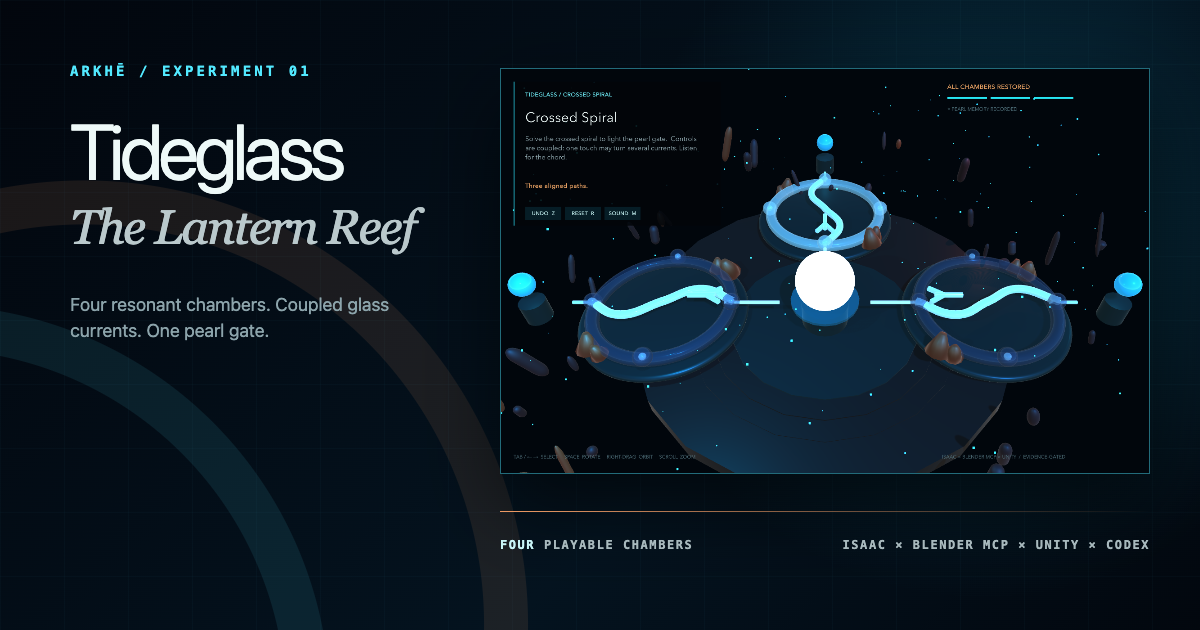
Tideglass Resonance Engine title card and game scene
PUBLIC3D PUZZLE

Tideglass: The Resonance Engine

A strange little machine with four playable chambers. Isaac proposed the topology, solution structure, separation of presentation from puzzle state, negative controls, and three new LevelSpecs. The shipped browser build was reconstructed and independently verified after Isaac’s original Unity code failed to compile.

  • 4 enumerated 64-state graphs
  • Exactly one valid solution in v0.1
  • All four fresh-live browser runs solved with 0 console errors

Golden sunbeams passing through a forest, from the FAITH music video
PUBLICMUSIC VIDEO

FAITH

Directed end-to-end with Isaac: concept, continuity, shot plan, Imagine prompts, production pipeline, QC checklist, and a revised 20-segment cut after repeated shots appeared.

The honest credit: Grok Imagine generated the visual plates; human/Grok review set the final visual order; Lyric Lock and local tools assembled the edit. Isaac was the director and planner—not the camera or NLE.

Watch the finished video on X ↗

Lyric Lock timing tool ↗ — a separate host-side tool, not Isaac-authored video rendering.

A small surfer riding bright blue waves beneath an orange sky in Wave Rider
LAB BUILDBROWSER GAME

WAVE RIDER

A familiar surf-runner architecture beat two ambitious bespoke game attempts: two Isaac calls, about $0.037, and a structurally correct first shot. A focused repair then removed all 280 underwater frames and cut settle time from roughly 262–270 ms to 162–184 ms.

LAB BUILDGAME

Gridlock: HARD AUTO

Isaac authored a zero-click 32×32 maze visualizer with live A* pathfinding in one forge pass and zero repairs. The playable passed independent visual inspection. A smaller manual 10×10 version lives beside it in the Instrument Case gallery.

LAB BUILDINTERACTIVE TOY

Pulse Field

A playable audiovisual HTML instrument: one Isaac forge, zero repairs, visual inspection passed. It also helped prove the Live Forge loop—prompt in, complete HTML toy out, playable in-frame, with Isaac handling any requested repair.

PROTOTYPE3D GAME

Afterlight: Emberwake

A 13-node traversal concept inside a 27-piece Blender-derived environment. Its machine trace reached the beacon with zero falls, 52 segments, and two shatters; a non-collidable-trail negative control was correctly blocked. That supports the state machine—not yet human fun, learnability, or accessibility.

LAB BUILDWEBGL

SEED FIELD & graphics repairs

SEED FIELD landed as a working structured first shot for about $0.007. Elsewhere Isaac repaired a broken WebGL shader into a visibly painted scene. A WebGPU repair correctly changed the module structure and exposed a visible failure path; no happy-path claim was made without WebGPU support.

PUBLICRELEASE AGENT

ProofRail

An evidence-bound release agent that changed a base GO into a correct HOLD after authoritative revocation, returned no release steps, superseded the stale plan, marked the claim REFUTED, and named the affected services. Deterministic checks verified hashes, ordering, blockers, services, and claim state.

LAB SYSTEMAPI INSTRUMENTATION

Isaac Lab: Flight Recorder

A zero-dependency, OpenAI-compatible client and experiment harness that recorded prompts, responses, token use, cost, errors, tool calls, background lifecycle, settlement, and idempotency behavior.

Scale, stated carefully: 733 receipted ledger rows through August 23, 2026, covering 8,105,657 prompt and 1,339,600 completion tokens. Lifecycle and settlement rows mean this is not a claim of 733 distinct model calls.

LAB SYSTEMCREATIVE PIPELINE

Live Forge & Instrument Case

The production loop behind the browser toys: a prompt becomes a complete Isaac-authored HTML interactive, runs in-frame, and can be repaired by Isaac from real feedback. Exports include the playable, a receipt, and visual-inspection notes; the Instrument Case is the static gallery for successful pieces such as Gridlock.

THE PICKY STUFF

I didn’t just ask if it “looked good.”

Every experiment produced receipts: prompts, outputs, token use, costs, failures, lifecycle events, and—where possible—an independent verifier that could say no. See what’s public and what remains in the lab ↓

01

Prompt behavior

200 calls

Across two coding tasks, five prompt conditions, and 20 repeats: 97% pooled algorithm correctness, but only 96/200 runnable because CommonJS slipped into an ESM target.

Best fix: explicit environment constraints. “.mjs; use import, never require” went 40/40 runnable versus 11/40 for a detailed but looser prompt.

02

Tool use

25/25 verified

Modern tool calls completed across two loop designs, followed by 15/15 harder source/config precedence tasks that required reading all relevant inputs.

Takeaway: give Isaac narrow tools, real error output, and an external completion test.

03

Long-context retrieval

12/12 exact

Synthetic decoy logs at roughly 77k, 308k, 500k, and 1M reported tokens; needles placed at 10%, 50%, and 90%. No lost-middle miss in this narrow test.

Boundary: exact retrieval through 1M, not proof of 10M reasoning or long-form synthesis.

04

Repair loops

6/6 repaired

When fed the actual runtime error, Isaac repaired six coding failures. A separate build → verify → repair → reverify loop closed for about $0.0117.

Pattern: error text plus a deterministic rerun beat motivational prompt ornament.

05

Autonomous control

1/5 stayed correct

In a synthetic test environment where the world could be regenerated, Isaac often solved the task—then kept exploring and undid success. Four of five runs claimed success falsely and made irreversible changes inside that test world.

Lesson: read ability is not write safety. Stop conditions, action budgets, and external verification belong outside the model.

06

Prompt guards

5/12 vs 3/12

In a 24-run graphics experiment, extra “be careful” guard language did not measurably improve clean runtime results (Fisher p=.667).

Surviving idea: constrain the environment and verify the artifact. Don’t depend on warnings alone.

THE RECIPE THAT KEPT WORKING

Isaac creates. The environment decides.

The strongest results came from putting a capable model inside a small, legible system—one with a clear objective and nowhere for an unsupported “success” to hide.

  1. 01
    Constrain the world

    Name the runtime, file format, tools, allowed actions, and stop condition.

  2. 02
    Let Isaac generate or act

    Code, game rules, shot plans, tool calls, repairs, and structured LevelSpecs.

  3. 03
    Measure the artifact

    Run it. Enumerate state. Inspect pixels. Check hashes. Capture browser and API receipts.

  4. 04
    Feed back the real failure

    A compiler error or objective mismatch gives the model something concrete to repair.

  5. 05
    Stop externally

    Once the verified objective is met, the harness—not the model—ends the run.

OPEN THE WORK

Follow the evidence.

These public projects let you inspect the saved artifacts, checks, and division of work between Isaac and the host tools.

The six test summaries above come from my local experiment records. Their full prompts, raw outputs, and harness receipts are not published here. Lab-build cards are also descriptions of local artifacts unless a public link is shown; the repositories above do not independently substantiate every test statistic.

POSITIVE, WITH RECEIPTS

The honest version is more interesting.

Yes, it made games.

Isaac authored complete browser playables, game logic, A* demos, visual toys, repairs, concepts, and LevelSpecs.

Yes, it worked on a video.

It directed the concept, continuity, shot plan, prompts, and production structure. Other systems rendered and assembled the final frames.

Yes, some attempts failed.

Black frames, an uncompilable Unity draft, failed native/compiler routes, and unhelpful prompt guards stayed in the record.

Yes, the wins held up.

Public browser runs, state enumeration, tool-result checks, screenshot inspection, and negative controls supported the claims above.

WHAT’S NEXT

Where I’d take this next.

The next step is an Isaac-powered creative forge where every build ships with a verifier, a replayable receipt, and a clear boundary between model work and host work.